An Archive of manuscripts and memorabilia related to the Life and works of Sir Edward Elgar, collected by Arthur Reynolds. Please note that the following catalogue is a distillation of Arthur Reynolds' much more detailed description. In order to make available a description of all items, an AI script has been applied to the original catalogue so that it can be compatible with an online cataloguing structure. The rest of the catalogue descriptions will be added to these entries in due time. Until that time, if you wish to know if there is more information on any material listed herein, please contact the archive.
Thanks to the generosity of Arthur Reynolds and the National Heritage Memorial Fund, in Autumn 2026 the Hallé Archive has become the new home of an exceptional archive of 1,500 Elgar artefacts.
Spanning autographed manuscripts, first-edition scores, correspondence with his contemporaries and personal items that reveal glimpses of Elgar’s everyday life, the collection offers an unrivalled insight into the world and work of one of the UK’s most celebrated composers.
The archive also shows how Elgar was one of the first composers to embrace new sound recording technology – going on to play at the openings of both the first HMV retail store and what would later become Abbey Road Studios.
The archive will be housed in the Hallé's current archive facilities in Bridgewater Hall and will be available for the public to view, by appointment, from September. Mr Reynolds' detailed catalogue will be added to the orchestra's online resources on the Connecting Manchester's Music Archives website, enabling everyone to explore what the archive holds. Some items from the collection will be included in future exhibitions and the Hallé aims to create a permanent new, fully accessible archive in the future.
Arthur Reynolds
Built over six decades by Arthur Reynolds, a New Jersey-based businessman and Chairman of the North American Branch of the Elgar Society, the archive brings together around 1,500 meticulously catalogued Elgar-related artefacts and has now been donated to the Hallé.
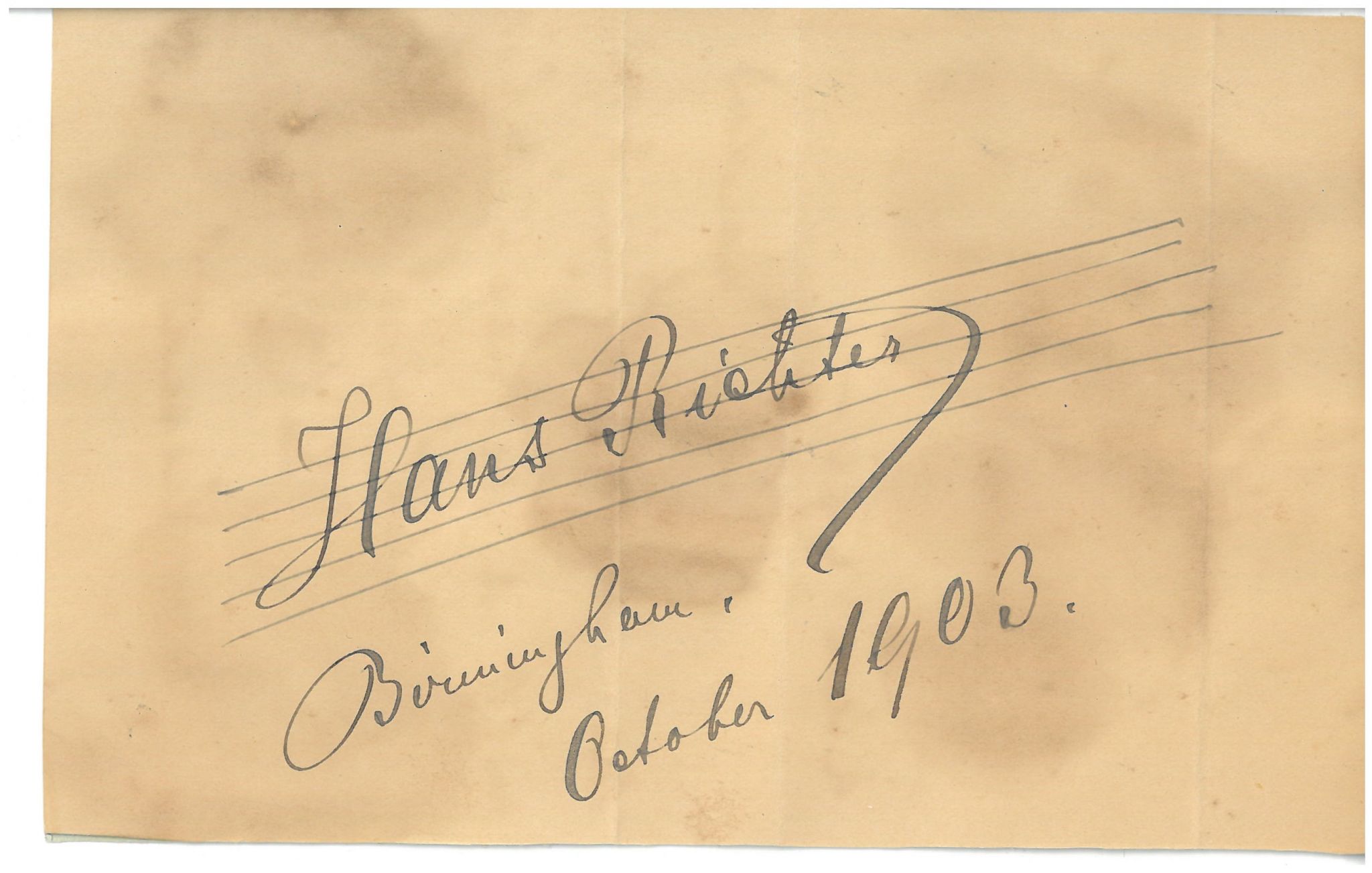
Arthur Reynolds, was keen that the archive remained together in full and become publicly accessible. Reynolds donated the archive to the Hallé in recognition of their historic connections with Elgar – the composer was friends with the Halle’s second Principal Conductor Dr Hans Richter and the Hallé orchestra premiered Elgar’s Symphony No 1 in 1908 at the Free Trade Hall in Manchester.
Journey from the USA to Manchester
The archive was flown from New Jersey to London, driven up to Manchester and finally carried through the doors of The Bridgewater Hall in a 3,500 mile journey funded by the National Heritage Memorial Fund.
The National Heritage Memorial Fund awarded the Hallé nearly £105,000 to support the legal aspects of the donation and enable its transport to the UK – a vital piece in the puzzle to save the archive and prevent it from being split up.
Essential parity funding was also provided by long term Hallé Patron and generous philanthropist, Carole Nash, to help bring the Arthur Reynolds Elgar Collection back to the UK.
“We are honoured to be welcoming this incredible collection to its new home with us at the Hallé. We are so grateful to Arthur Reynolds for entrusting us with its care, to Carole Nash and the National Heritage Memorial Fund for their crucial support, and to all involved for their shared commitment to making this collection available to the public.
“Elgar’s work is inextricably woven throughout the Halle’s history, and it is a privilege to be able to bring this incredible legacy to life through this diverse and fascinating archive. The Hallé Archive already holds some of the most exciting artefacts in musical history, and the addition of this extraordinary collection marks an important step in our ambitions to opening up public access to these treasured items and the stories they hold.”
David Butcher, Hallé CEO
Search the Collection
Browse the full Arthur Reynolds Elgar Collection (Hallé Archives) Collection
Provenance: Arthur Reynolds on the provenance, "In May 2000, I received word that a couple of items of correspondence between them, concerning the work, were being offered as a single lot (Lot 32) at an obscure Christie’s South Kensington book sale scheduled to tak
Dates: 1841-1906
Description: Fanny Davies (1861>1934) ranked among the most celebrated pianists of her generation. She met Edward in 1893 at the Baker house In Gloucestershire. Elgar produced Allegro (Concert Solo) aka Concert Allegro in response to her request; Davies is the dedicatee.
Creator: Elgar, Edward William (1857-1934), Knight, 1st Baronet, composer
Provenance: Unless otherwise marked, the provenance of the following materials is either Sotheby’s May 16, 1996 auction sale of the Novello & Co. archives, or Bloomsbury’s subsequent auction of the Novello & Co. material unsold at the Sotheby’s sale. Unless oth
Dates: 1897-1932
Description: Novello & Co. served two functions: Clients’ music publisher and clients’ performance agent. Letters relating to Novello’s role as Elgar’s publisher form the first part of this ‘Correspondence’ section. The second part, a group of 239 letters (49,000 words), includes mostly unpublished correspondence filed in “dockets,” relating to Novello’s function as Elgar’s concert agent. Among these letters is a nearly complete file of the Violin Concerto agency correspondence as well as a less extensive file on Symphony No. 2, offering penetrating glimpses into Novello’s dealings with Elgar as a concert artist as well as information about the demand for early performances of both works. Of particular interest is a complete file on Ysaÿe’s ‘piracy’ of the Violin Concerto performing rights. When it came to both publishing and performance-related matters, Elgar’s chief correspondent at Novello was Alfred Henry Littleton, the firm’s Chairman from 1886 until his death in 1914. Afterward, Elgar corresponded chiefly with Henry Clayton and Harold Brooke.
Description: Elgar’s lifespan corresponded to the Golden Age of portrait photography in Britain. Among the professional studios represented in this Archive that produced portraits and group photos of the composer and his circle are the following: Thomas Bennett & Son, aka Bennett of Worcester, established his studio in Worcester’s Foregate Street in 1856, the year before Elgar was born. When Bennett died in 1879, his son - also Thomas - moved the studio to 8 Broad Street. Bennett father and son specialized in cabinet-card and carte-de-visite portraits. Both Bennetts contributed important images to this Archive. William Ward Dowty (1887-1979) purchased the Bennett studio in 1913, extending the portrait photo business to the production of landscape views sold as postcards in local shops. Michael Dowty, son of William Ward, pursued his father’s métier, becoming a freelance photographer of houses for sale, working chiefly for Andrew Grant, a Worcestershire real estate agent. A passionate Elgarian, many of the images housed in this Archive were photographed or copy-printed by Michael Dowty for JNM’s Elgar a Life in Photographs, the original copies of which are found in this Archive. George Evans, aka Evans of Tallow Hill, was one of the elder Bennett’s rivals for the trade of the Elgar family and their contemporaries. Several important images of Elgar and his friends in this Archive come from the Evans studio. Ernest Walter Histed (1862–1947) was born in Brighton, but emigrated to the United States, where he established successful studios, first in Chicago, then in Pittsburgh before returning to London to set up a studio in New Bond Street and later in Baker Street. The Histed Studio was well-known for its portraits of H. Rider Haggard, Clara Butt, and Queen Victoria, as well as the Order of Merit recipients, including Elgar. The Elliott & Fry Studio. Founded in 1863 by Joseph John Elliott (1835 – 1903) and Clarence Edmund Fry (1840–1897), the firm's core business was taking and publishing photographs of the Victorian public and social, artistic, scientific and political luminaries. During World War II the studio was bombed and most of the early negatives were lost. Herbert Richard Lambert (1882 - 1936) was known for his portrayals of professional musicians and composers, including Elgar. Lambert learned his trade at the Elliott & Fry Studio, of which he became Managing Director in 1926. Subsequently he left London to open his own studio as Herbert Lambert of Bath. Desmond Tripp succeeded Herbert Lambert, acquiring the Lambert studio in 1947. Tripp expanded the studio’s activity via a network of UK-located photo processing shops. Many of the photographs in this Archive were either printed or copy- printed by Tripp. The Vanderweyde Studio. Henry Vanderweyde (1838–1924) was a Dutch-born English painter and photographer, best known for his photographic portraits of the late 19th century. His is considered a pioneer in the use of electric light in photography. J. Russell & Sons. The firm of James Russell and Sons was formed in the mid 1860s by James Russell (1809-1899) with his sons, who also became photographers. James Russell (1835-) formed a business in Lewis in 1858. Josiah Russell (1839-) established a studio in Littlehampton in 1860. James' daughter Ruth married John Fielder (1836-) who also joined the firm’s photographers. Reginald Haines. Born in 1872, Haines established his studio in London’s Southampton Row, where he became well known and highly regarded for his portraits, especially for his images of members of the Asquith government. Unfortunately, most of Haines’s negatives were destroyed in the Blitz. Coy entered the ranks of Worcester photographers in 1920, locating his studio at 57 The Tything. After World War II, Geoffrey Hopcraft took over the studio, but kept the Foy trading name. Numerous photographs in this Archive, printed or copy-printed by Hopcraft and stamped Foy Studios on the verso, were commissioned by JNM for Elgar a Life in Photographs. Vivian Durant, aka Vivian of Hereford was that town’s leading studio between 1930 and 2000. Some of the last images of Elgar in this Archive come from the Durant studio. In addition, a number of competent amateur photographers have left us portrait images of Elgar. Among those represented in this Archive are: Edgar Thomas Holding. A tailor by profession, E. T. Holding (1870-1952) was a Fellow of the Royal Photographic Society. He lived opposite August Jaeger in Margravine Gardens, Barons Court, where he produced iconic images of Elgar, Jaeger and others. William Eller, Elgar’s friend based in Ledbury who brought his camera to a pre-arranged lunch date at Birchwood on the day Elgar completed the full score of The Dream of Gerontius. Max Mossel, the Dutch violinist who produced images of Elgar, Sinclair and others while Mossel was staying with Sinclair in 1896. Harold Wintle, tutor to William Meath Baker’s Sons, snapped a series of images of Elgar during Baker’s September 1901 house party at Hasfield Court. Dr. Charles F. Grindrod (1847-1910), a Malvern photographer who exhibited large tinted bromides of landscapes and genre scenes in the early 1900’s. He was also well known and highly regarded for his portraits, including arguably the most incisive image ever taken of Elgar, an original print of which is found in this Archive.
Postcard images of Elgar together with people, places and things that influenced him
Description: The entries listed below are grouped to two categories: People - chiefly studio portraits printed as postcards - and Places & Things. Those marked in red with jpg numbers are available in scanned copy format. The items cited as, "published in Elgar, a Life in Photographs" were acquired in 1993 from Jerrold Northrop Moore ("JNM"), who published them in 1981. Subsequently, the publishers inadvertently destroyed the negatives, so these photos are the only surviving images for Dr. Moore's photo-biography. Some of the entries will be in RPPC (Real Photo Post Card) format. A real photo postcard is a continuous-tone photographic image printed on postcard stock. The term recognizes a distinction between the real photo process and the lithographic or offset printing processes employed in the manufacture of most postcard images.
Provenance: All the discs listed below were purchased from JNM unless otherwise indicated.
Dates: 1914-1927
Description: During the 20-year period between 1914 and 1934, Elgar conducted his compositions for The Gramophone Company [aka His Master’s Voice or HMV] during 55 recording sessions. The surviving discs produced from these sessions, most of which are now lodged in this Archive, fall into two categories: test copies of both unpublished and published takes, and published recordings originally issued within the HMV catalogue. The listings below are arranged in order by chronological session number. The Archive also houses the discs, published by HMV and other studios, of the recordings of Elgar works by other conductors. Published discs are identified by their catalogue entry numbers. Test pressings are catalogued using their Matrix numbers.
Electric gramophone recordings of Elgar works conducted by the composer and others
Provenance: All the discs listed below were purchased from JNM unless otherwise indicated.
Dates: 1927-1929
Description: During the 20-year period between 1914 and 1934, Elgar conducted his compositions for The Gramophone Company [aka His Master’s Voice or HMV] during 55 recording sessions. The surviving discs produced from these sessions, most of which are now lodged in this Archive, fall into two categories: test copies of both unpublished and published takes, and published recordings originally issued within the HMV catalogue. The listings below are arranged in order by chronological session number. The Archive also houses the discs, published by HMV and other studios, of the recordings of Elgar works by other conductors. Published discs are identified by their catalogue entry numbers. Test pressings are catalogued using their Matrix numbers.
Description: The items listed below were at one time located within this archive. Presently they are missing. If stolen, they may presently reside in someone else’s possession but are more likely to have been lost.
 Donate
 Upload